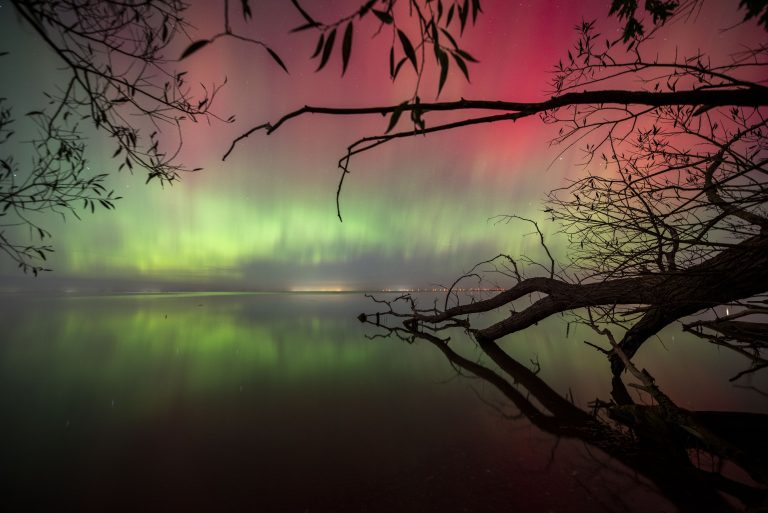

Photo (above) by Jeff Peacock. You don’t have to go far to view something special like this beauty. In fact, this image of the Northern Lights was captured at Tremblay Beach Conservation Area in Stoney Point. It was taken with a DSLR camera with ultra-wide-angle lens, but nearby teens shot their own beautiful images simply using their cellphones.
Why sky-gazing is good for your health
Some people head to the gym to release the stress of a long day. Others take to their favourite lounge chair to unwind with a book. And still others, like Jeff Peacock, simply walk out into their backyard and look up.
It wasn’t always this way. In fact, forty years ago, barely out of high school, Peacock was feeling a bit anxious about the future. “Age 20 hit me hard for some reason,” he recalls. Then came the media hype about Halley’s Comet, marketed as a must-see cosmic event. “It was 1986 and I heard about this comet coming in and I thought oh, this is something I’ve got to see. A once-in-a-lifetime thing, with the next one 75 or so years away. It piqued my interest.”
With a new-found interest, Peacock got in touch with a member of the Windsor Centre of the Royal Astronomical Society of Canada (RASC) and invested in a small starter telescope. He took photos of Halley’s Comet that year, both here and in the sky above Florida. And he’s been looking up at the sky ever since.
“You get a sense of awe, a sense being small, but a sense of belonging too,” he says about the vastness up there and what he feels when he gazes into the sky above his home in Tecumseh. “You realize you’re here for a short period of time and you kind of want to make the most of it. And as you get older too, you realize that stuff that used to bother you shouldn’t bother you any more in real life.”
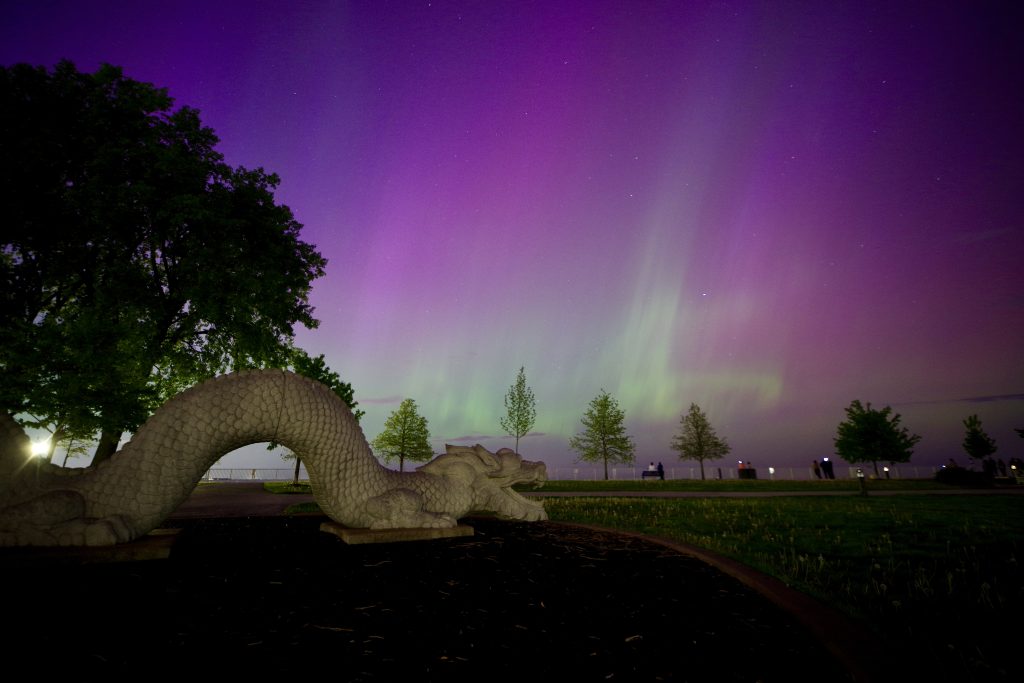
Photo by Jeff Peacock (above) This otherworldly image of the Aurora Borealis was taken in Tecumseh at Lakeside Park at Riverside Drive and Manning Road using a Pentax k1 DSLR camera with Irix 15 mm lens, three-second exposure at F2.4 ISO 1600.
That sense of awe, purpose and calm – of being grounded and humbled all at the same time – is exactly what psychologists have been preaching as a natural stress reliever, a sort of cosmic happy pill. British researcher Paul Conway, who coined the term skychology in his 2019 study on sky-gazing, found that looking at the ever-changing sky was an everyday opportunity to experience the extraordinary in the ordinary. “Positive activities boost emotions, thoughts, behaviours, and satisfaction, all of which enhance well-being,” he wrote in his analysis.
The good news is that this sky-gazing medicine is free for all and easily accessible, even if you live in an urban area where the skies aren’t as dark as they would be if you travelled to the wilds of, say, the Northwest Territories, known for its Aurora Borealis displays.
Peacock’s celestial photos prove you don’t have to go far to view something special up above. In fact, it was at Tremblay Beach Conservation Area in Lakeshore where, with the help of an Aurora-tracking app, he was able to capture the majesty of the Northern Lights in fall 2024. He had his fancy telescope that night, but all you need to see is many of the nighttime gifts in the sky are binoculars, or even your smart phone.

Photo by Jeff Peacock/Steve Mastellotto. This image of the cosmic powerhouse Andromeda Galaxy M31 is the result of a collaboration between two members of the local astronomical club. The photographer used a telescope with light pollution filter and equatorial mount to take a one-minute photo 210 times over 3.5 hours. He processed the image, then sent it to his friend Steve Mastellotto to enhance it to the next level. Fun fact: Andromeda contains about one trillion stars.
In August, all you’ll need are your bare eyes to enjoy shooting stars galore, thanks to the annual Perseid Meteor Shower that sends streaks of light raining down on Earth from outer space. Bring a chair and sit on the beach in Point Pelee National Park where local astronomers will be hosting a shower party. In the meantime, you can find out more about the sky above Windsor-Essex by attending a meeting of the local RASC. The group’s monthly meetings at Ojibway Park Nature Centre are open to the public and are held on the third Tuesday of the month, except for July, August and December.
This summer, whether you find yourself on a blanket under the trees in Seacliff Park in Leamington, fishing off the pier at the Belle River Marina or kayaking on Cedar Creek in Kingsville, it’s nice to know that sky-gazing can help keep you and your mind healthy. As Mr. Peacock says: “Just look up and see what you’re missing.”