

Dr. Janelle Abela on growth, connection, and the power of difference in every space she enters
“Oh, I think you’re muted,” Dr. Abela said, laughing, as I fumbled with my microphone.
It was the height of COVID, and I had been assigned a story on Dr. Janelle Abela, a woman with a voice, a mission, and the drive to make a difference. We had crossed paths before, but this was our first real conversation, and like most connections at the time, it unfolded through pixels, lag, and microphone errors.
Now, years later, as an attendee of Dr. Abela’s Thought Leader dinners and community initiatives, I have been able to witness that same passion, but on a much larger scale. “I’m so glad you’re writing this!” she exclaimed on a phone call. “I feel like this is a full-circle moment.” I laughed, taking in the weight that this piece carries: layers, experiences, and nuance worthy of a cover story. “Can I put this in the story?” I replied with the same excitement.
From the front line to the production line to the finish line, Dr. Abela’s work revolves around people, pressure, and the possibility of what could be. As the Founder and CEO of Diverse Solutions, she is a Growth Strategist focused on improving workplaces and transforming how people exist within them.
But ask her what growth means, and she doesn’t default to metrics or milestones. Instead, her perspective is shaped by the experiences she’s gained across industries, translating complex concepts into practical solutions.
In partnership with St. Clair College, Dr. Abela has developed the Advanced Law Enforcement program, built from her research and training with policing organizations across Canada and the United States. The program focuses on leadership, communication, and trust-building within high-pressure environments, bringing theory into real-world, day-to-day application.
In the manufacturing sector, her work continues at a national scale through her partnership with Excellence in Manufacturing Consortium (EMC Canada). There, she develops and facilitates programming focused on inclusive workplaces, women in skilled trades, and learning differences, supporting organizations across Canada in building stronger, more adaptable teams amid labour shortages and shifting workforce demographics. It’s work that reinforces her belief that innovation happens when teams understand and harness differences.
The phrase “Leading the Line” might evoke structure, discipline, even uniformity, something Dr. Abela is very familiar with in her work. But for her, the concept isn’t about staying within the lines, it’s about recognizing when those lines no longer serve the people within them.
“I work on the line,” she says, “because sometimes the line needs to be blurred, moved, or stepped off entirely.”
It’s a perspective shaped by years of navigating spaces where conformity is expected and challenging it can feel uncomfortable, even risky. “Consistency and conformity are comfortable but for who, and at what cost?” she asks.
In a time where voices are growing louder and more diverse, she believes the traditional “line” can no longer be the standard. People aren’t uniform, and our systems shouldn’t expect them to be.
Much of her work lives in conversations people don’t always want to have about difference, power, communication, and culture. What sets her apart is how she brings people into those conversations. Dr. Abela has adopted what she calls the “why care” methodology, a concept that first gained traction during a pivotal 2019 conference, where she challenged educators to rethink how they engage students.
“I recall saying something along the lines of, ‘we care about how much money we have in our bank account, our pets, or if our fast-food order was made correctly… why? Because we are invested in the outcome.’ I wanted teachers to see that if we want students to digest information—not just move through a class—we need to show them the value and get their buy-in,” she says. “So instead of telling people they should care, I show them why it matters to them.”
That might mean walking through real-life scenarios – a product defect on a manufacturing line, an error in a healthcare process, or a split-second decision under pressure – and unpacking how human behavior shapes operational outcomes and risks. “There are three parts to it: relatability, buy-in, and low-risk conversations,” she explains. “If people feel safe, they’ll engage. If they engage, they’ll understand.”

In one of her sessions, Dr. Abela recalls asking participants to share experiences from concerts or sporting events. One man casually described how he would buy cheap seats at a hockey game, then slowly move closer to better seats as the night went on. Mid-story, something shifted.
“He stopped and realized what he was saying,” she recalls. “He started connecting it to how he moves through the world, what he can get away with, what isn’t questioned.” That moment became a gateway into a deeper conversation about privilege, perception, and access.
“That’s the goal,” she says. “Not to force people into understanding, but to let them arrive there themselves.”
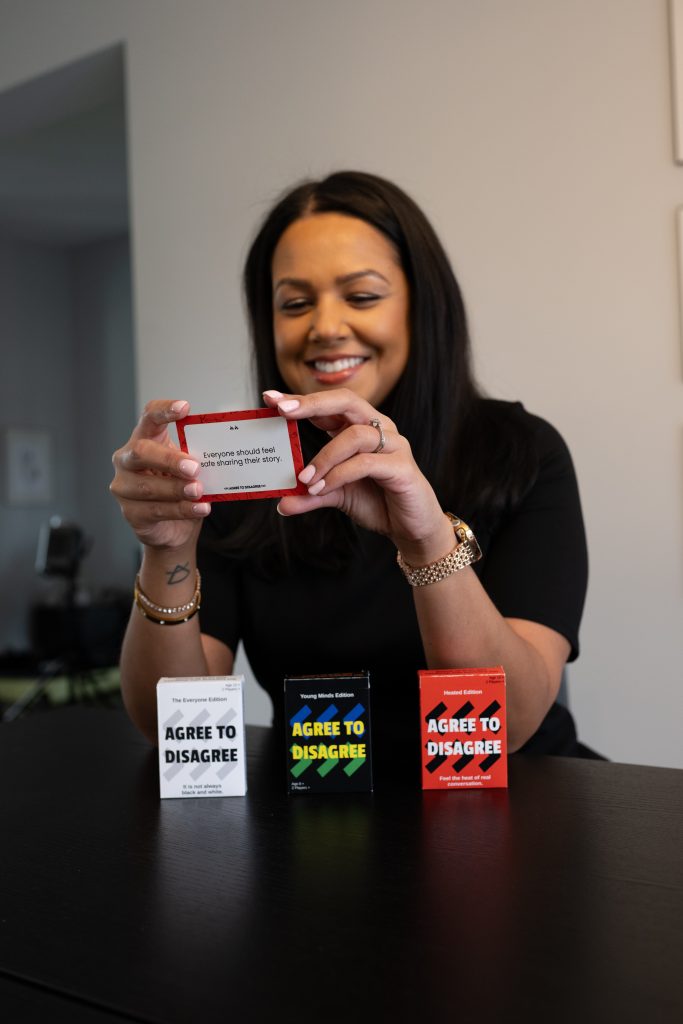
Even in the most unexpected settings, the results can be powerful. She remembers facilitating a session with a group of senior police officers using one of her deceptively simple signature tools, her Agree to Disagree card decks. “It got heated,” she laughs. “People were slapping the table, laughing, completely invested,” but beneath the humour, there was a shift in perspective. “They were able to take that energy and immediately connect it to real-life situations and how different viewpoints show up in their work.”
Built from her background in education and workplace facilitation, the cards are designed to spark low-risk, high-engagement conversations that build critical thinking and communication skills. The concept of difference (not as a problem, but as a resource) is the core of Dr. Abela’s evolving platform: The Divide Guide.
Growing up, she moved frequently, never quite rooted in one place.
“I never really had a constant social group in my life,” she explains. “I moved quite a bit growing up, with only a few years in each school. Being mixed race, living in different countries, with parents from different countries I was always in the divide, navigating how to present myself, how to act, how to fit in, how to belong.”
For most of her life, those differences felt like the problem. Over time, that perspective shifted.
“The more I came to understand my own experience, the more I came to value those differences and how they gave me a unique perspective on the line itself.” Now, she’s helping others do the same. “Difference is where innovation comes from,” she says. “If we all think the same way, we get the same outcomes. But different perspectives? That’s where new solutions live.”
Across all the industries she works in, one theme consistently emerges: psychological safety. “If people don’t feel seen, heard, or valued, everything suffers,” she explains. “They disengage, they make mistakes, they stop sharing ideas.” Those impacts show up operationally, too. “Small problems become big problems. Innovation slows down, and the cost becomes exponential.”
In Dr. Abela’s view, many workplace challenges can be traced back to this one issue. “The way we treat each other is either building safety or breaking it,” she says. “And the solution? It’s often simpler than we think. It’s care.”
In 2020, at the height of global uncertainty, she made a decision that changed the trajectory of her life, she left the classroom to build her business full-time. “It was stressful,” she admits. “That uncertainty doesn’t go away, it just changes.” During that time, she worked with the team at WEtech Alliance, where she was introduced to Director of Venture Services and Partnerships, Adam Castle, whom she describes as a “friend and mentor,” and has since shown immense support in her work and vision.
Her work, after all, is tied to people and people are influenced by politics, culture, and shifting social narratives. But the risk gave her something she couldn’t find in the public sector. “Freedom, control, and the ability to build something without the red tape,” she explains. “I’ve always been someone who thinks, ‘what’s the worst that can happen?’ So why not try?”
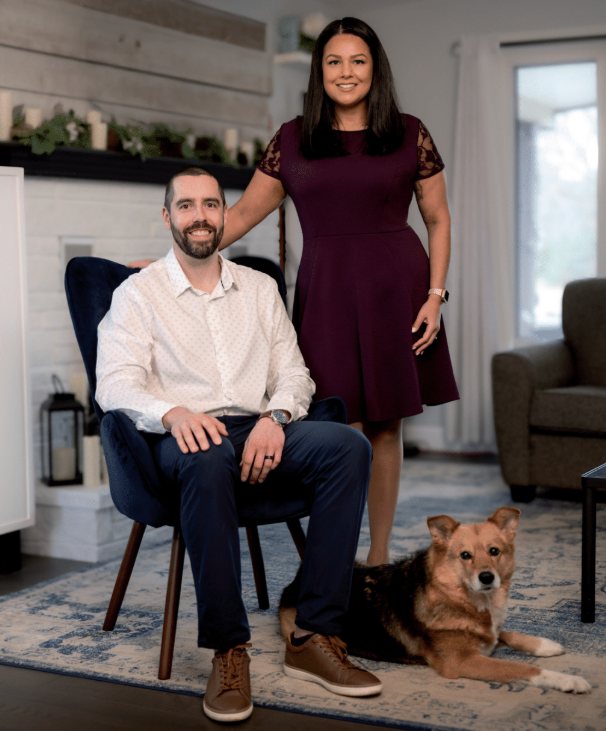
For someone who spends so much time holding space for others, Dr. Abela is quick to acknowledge that she doesn’t do it alone. Her husband, Joshua Abela, a Controls Engineer with The NARMCO Group, has been a constant source of support, doubling as her unofficial translator for industry jargon.
“My husband has always been a person who holds my value steady and reiterates it in the darkest times,” she explains. “When I’m being hard on myself, he reaffirms my worth, centers me, and hears me. Even though our experiences in life have been quite different, somewhere along the way we became one. He feels what I feel and has not just become a sounding board, but an ally and advocate for me.”
And in the quieter moments, it’s their puppy, Zoey, who offers balance, pulling her outside for fresh air and grounding them in the familiar patterns of everyday life.
It’s from that foundation that her understanding of growth begins. “Growth comes from psychological safety and openness,” she explains. “A willingness to change. When you’re open to new ideas, you open yourself up to new opportunities, new connections, new solutions, and new ways of understanding yourself and others – compounded when you’re in a psychologically safe space to do so.”
Outside of work, she describes herself as curious and endlessly interested in people. She laughs easily, asks questions freely, and resists the idea that professionalism has to mean seriousness. “I like to learn with people,” she says. “Not teach at them.”
That momentum continues to grow through her work with Disrupt HR, where she brings her message to stages beyond traditional workplaces. From speaking at Disrupt ATX to collaborating locally with Meighen Nehme and The Job Shoppe for Disrupt YQG, Dr. Abela continues to push conversations forward, challenging audiences to think differently about leadership, culture, and connection.
Most recently, she was recognized as a top 50 voice for manufacturing and the Young Business Professional of the Year in LaSalle, a reflection of the growing impact of her work across industries and communities.
As Dr. Janelle Abela continues to grow as The Divide Guide, her vision is clear. She doesn’t just want people to tolerate difference; she wants them to value it. “It’s not enough to be open,” she says. “We need the skills to actually navigate differences, to work within it, to grow from it.”
Because at the end of the day, her work isn’t just about how organizations function, it’s about the people within them, and what becomes possible when we finally learn how to meet each other, wherever we stand on the line.