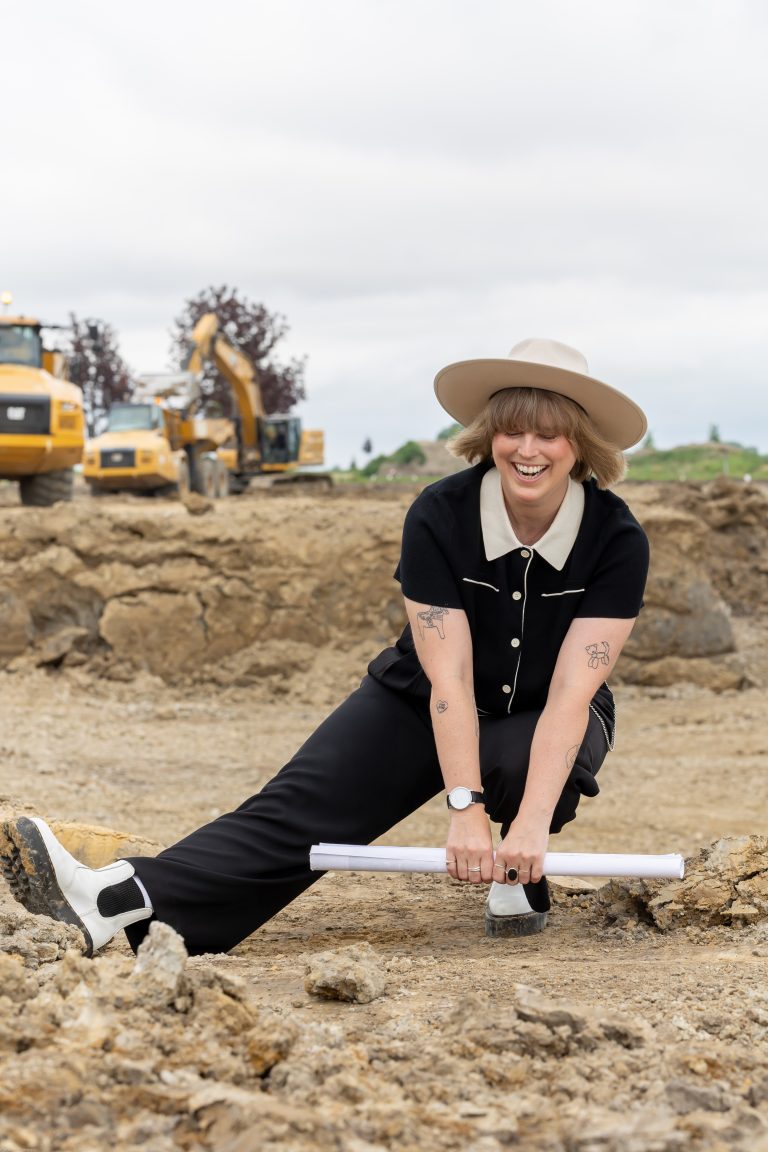
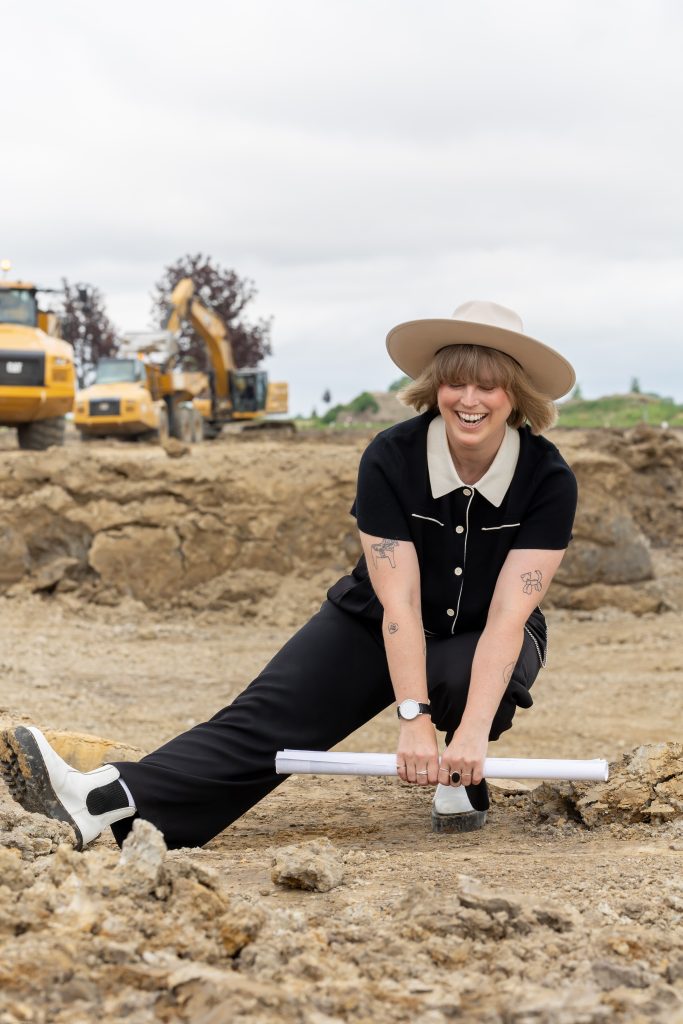
Golf Course Architect Christine Fraser Has Grand Designs for a More Inclusive Game
How do we save the game of golf from itself?
The first woman to hold a lead design role on a golf course in Canada calls Windsor home, and she has some ideas.
In a way, for Christine Fraser, design can be a matter of life and death.
“If it doesn’t become more inclusive and diverse,” warns the ascendant thirtysomething course designer, “golf might not be around in 50 years.”
Informed by her experiences in and around the sport, Fraser works in a design language she sees as socially responsible in form and function – one capable of creating courses that optimize and extend the “golf lives” of all players independent of gender or skill. Truly accessible courses, she argues, accommodate a wide spectrum of skill levels and are useable by as many people with disabilities or mobility limitations as possible. They also coexist comfortably with their communities and the natural world.
Fraser’s ideas, viewed through a certain lens, are radical, but the golf world has begun to take positive notice. Fraser has been written up by the Professional Golfers’ Association of America and featured in Charles Schwab’s The Challengers video-series, a web-based showcase of innovators in the sport. In 2023, she was entrusted with a full-scale renovation of the Toronto Hunt Club’s nine-hole course, considered by some the best in the country. Remarkably, a woman had never previously held a similar lead design role in Canada. At press time, the project, having been comfortably approved through a membership vote, is slated to come to fruition in 2028.
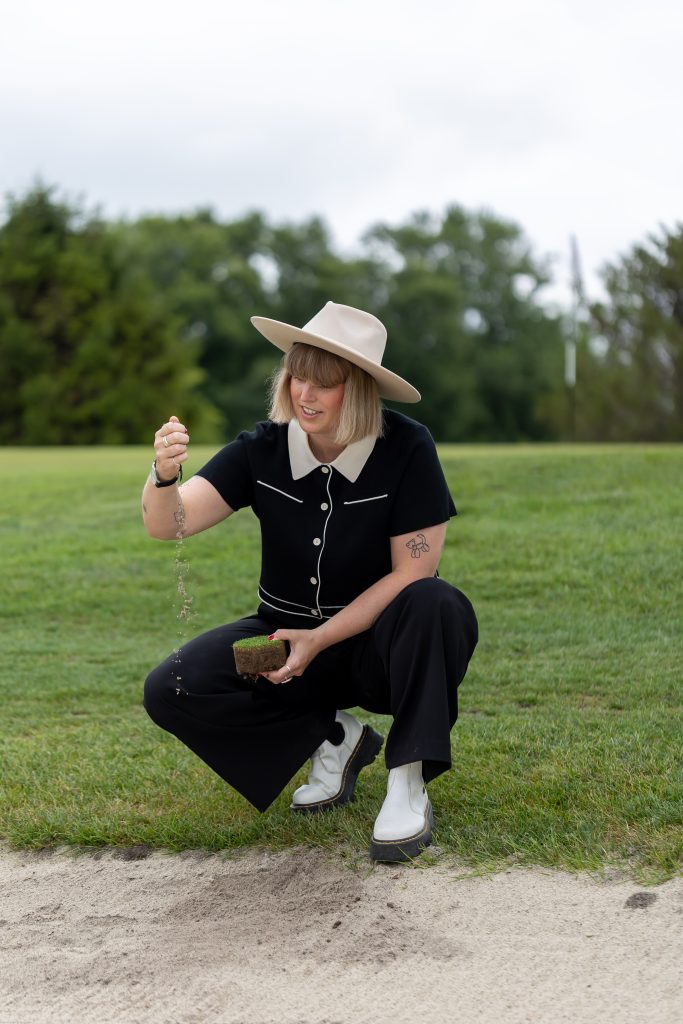
Closer to home, after years of drafting and discussions, Fraser recently broke ground on an exciting new development with Paul St. Pierre, founder and president of the LFX Group, owner of Belle River’s Rochester Place Golf Club & Resort, and – full disclosure – publisher of this magazine. “Every architect’s dream is a home court advantage,” she shares with evident excitement. “To have someone with Paul’s passion, vision, and resources so close to my community has been wonderful.”
Fraser completed a Master of Landscape Architecture (MLA) degree from the University of Guelph (2014), where she learned AutoCAD, tree identification, and much more. She holds an undergraduate degree in Sports Management from Stetson, Florida’s oldest private university, which she attended on a golf scholarship. Her MLA thesis, a study of sustainable golf design, earned a bursary in the name of Stanley Thompson, one of Canada’s most iconic course designers, which funded a data-collection trip to Scotland. There, she connected with Dr. Martin Hawtree, a major British architect. Fraser spent five productive years as an associate architect with his firm, based just outside Oxford, working on Open Championship venues like Royal Birkdale and Muirfield and other notable courses elsewhere in Europe.
Eventually, Fraser was ready to take the next step in her career on more familiar turf. “I decided it was time to come back to Canada and implement what I learned in the UK here at home,” shares the proprietor of the independent golf course architecture business Christine Fraser Design. Shortly after Fraser’s repatriation, her new partner landed a job in Windsor. Fraser followed; the two have called Windsor home since 2019.
These days, Fraser works with clients across the country, including several in Ontario and clusters of courses in the Maritimes, and keeps up some working relationships with European clubs. (“I have quite a few Aeroplan points,” she laughs.) The work varies: some smaller assessment and report-writing contracts can be measured in weeks, while other jobs involve ongoing annual consulting retainers. New developments or major course renovations are exciting, but planning, designing, and building can take up to a decade.
It would be foolish to understand Fraser only as “A Woman in Golf,” but gender does play an undeniable role in the development of her progressive design philosophy. Originally from Kingston, Fraser learned the game at Camden Braes, a family-owned course run by her mother and grandmother. “I always grew up with the understanding that women had a place in golf—that they deserved to be there—and so golf would open up spaces for people like me to participate,” says Fraser, who now recognizes both her naivety and ultimate correctness. “I never really thought that a woman in golf making big decisions was unusual or suspect in any way.”
At college, though, the cracks began to show: Fraser noticed the men’s team had more and better equipment, played nicer courses, and traveled more widely and comfortably. “It just felt like they had access to more opportunities and resources,” she says. “That was the start of my understanding that there were some inconsistencies and disparities within golf. It mattered who you were, what you looked like, and how much money you had.”
In the UK, having carved out a sizeable niche for herself in the game and now working on and around some of the world’s most storied courses, Fraser’s relationship with golf orthodoxy complicated further. “These historical institutions come with a lot of tradition, unspoken rules, and their own language, and I had to navigate that,” she recalls, “I was used to just showing up as I am, as myself, no holds barred, and I had that dimmed or dulled in certain instances.”

Somewhat unintuitively, as Fraser recalls, despite the “old boys’ club” at the top of the game, British golf institutions are integrated into their respective communities to an extent that borders of on socialist to North American sensibilities. “In Scotland, golf is seen as a service to the community rather than a business entity,” says Fraser, citing the world’s oldest golf course at St. Andrews as an example. “The course closes on Sunday and is used as a park. Anyone can go out there with their dogs, their kites, their running shoes, and walk the grounds. We’re talking about the most famous golf course in the world! There are dogs running across the greens! What that does is introduce people to golf in a different way that costs nothing and has fewer barriers to entry. You’re still immersed in the golf, and it becomes this multi-use space that both parties are benefiting from. Here, we put up our fences and security gates and have guards standing at the door.”
Importantly, in Fraser’s line of work, accessibility is neither a regulatory mandate nor a coincidence of uncontrollable environmental factors. Rather, it’s a design decision that can be made or not made. As she explains, pro shops, clubhouses, and parking lots – what landscape architects call “hardscapes” – must be built to comply with rigorous local accessibility frameworks. “But once you step on the first tee,” she continues, a note of disapproval in her voice, “all that is gone. You need to have handicap parking spaces, but once you’re on a golf course, you’re on your own. We can have a tee that is only accessed by stairs, we can have a green surrounded by a bunker that you have to cross over, we can have a bridge that’s only two feet wide.”
Essentially, Fraser is an advocate for universal design, a philosophy that argues a well-designed object or environment should be useable by as many people as possible without the need for adaptation or accommodation on a case-by-case basis.
“Golf has given me so much,” shares Fraser. “It was my playground growing up, and that sense of play has never really left. I just want that opportunity to be there for anybody who wants it, and I found there was space within the golf design world to consider those people who never were considered in original design of golf courses and really centre them in the process.
“What I’ve come to realize over the last few years of implementing these design decisions,” Fraser continues, “is that what’s good for women is good for everybody.”
For example, consider “slower-swing-speed” golfers, a group that includes women, yes, but also seniors, juniors, beginners, and people with injuries, and adaptive needs. Designing for that cohort, in Fraser’s words, “can be as simple as not having a forward tee pushed off to the side on a slope with no grass on it, that has to carry water, that’s pointing you into the woods.”
Critically, nobody needs to be disadvantaged by these choices. “At the Old Course at St. Andrews,” says Fraser by way of example, “the best players in the world can have their Open Championship on the weekend, and then the following Monday, your group of senior women can go out and play the exact same course and have an equitably enjoyable and challenging experience.”
Fraser’s progressivism extends to environmental justice and sustainability. To this end, she sees design that manages water consumption appropriately as one of the most important focuses of her work. While re-educating golfers to embrace a slightly unfamiliar aesthetic is a large part of the project, a designer schooled in sustainable practices can consider factors like fairway dimensions, grass species, and water harvesting and reclaiming systems.
“We’ve been indoctrinated into this idea that green, lush grass is better,” explains Fraser. “In the UK, there is a shared cultural understanding that firm, fast turf that’s maybe a little brown actually contributes to the creativity and excitement of a round rather than detracts from it. One of my roles as a golf architect is to educate people on the repercussions of what it means to have green grass all year round; it takes a lot of intervention. If you look at your lawn, throughout the year it browns, it greens, it gets thick, it gets thin. Golf courses, too, are living, breathing things that change throughout the season. It’s our job as golfers to accept that instead of imposing our views onto the environment.”
While Fraser concedes the often insular, impenetrable world of golf has a lot of work to do on itself, in this respect and others, she really does see green shoots of hope. “I think golf is in this really exciting place where it’s open to new ideas, voices, and perspectives,” she says, “and that’s largely due to the influx of new people into the game who come with interesting and nuanced and fresh perspectives that golf isn’t used to. I think we have a lot of exciting voices that are rising to the top that have interesting ideas and practical solutions to some of the problems that golf is facing now.”
She doesn’t say so herself, but Fraser’s voice is certainly one of them.