(L) Kim Willis, Director Communications & Mental Health Promotion and Nicole Sbrocca, CEO, CMHA-WECB
CMHA Windsor-Essex celebrates 55 years of helping build a healthier, stronger community
For over half a century, the Canadian Mental Health Association, Windsor-Essex County Branch (CMHA-WECB) has been growing alongside the community it serves, through good times and bad, giving us the support we need to live our best lives.
What began in 1971 as a small, local mental-health clinic has grown with the region to become one of the community’s most important healthcare providers, all while offering a broad range of services that reach much further than counselling and mental-health support.
CMHA-WECB currently offers 44 programs, employs nearly 250 full-time, part-time, and casual staff members, and works alongside healthcare providers, community partners, and its volunteers and donors to support the people of Windsor-Essex.
Alongside primary care and youth wellness, CMHA-WECB also helps with housing, bereavement, specialized psychiatric services and community education, to name a few. CMHA-WECB’s work reflects a holistic understanding of health that runs deeper than any single diagnosis.
“Where the agency started 55 years ago and the work we do today goes far beyond what people may realize,” explains CMHA-WECB CEO Nicole Sbrocca. “We started as a small community-focused mental health agency, and over 55 years, we’ve very much grown with the community.”
Celebrating their Emerald Anniversary, CMHA-WECB turned 55 years old this year. A remarkable milestone that reflects their commitment to the community and work in the region.
While mental health has always been a core foundation of CMHA-WECB’s mission, its expanding role in the community reflects a broader commitment to helping people access the care, resources, and connections they need at different stages of their lives.

Staff from CMHA-WECB
Caring for the whole person
A great example of their ‘whole person’ approach is the CMHA Health Centre, which provides primary care through an interprofessional team that includes physicians, nurse practitioners, chiropractors, social workers and other healthcare professionals. The Health Centre serves people who are in need of a primary care provider and offers services that include health promotion, nutritional support, and other healthcare options.
“A catchphrase that we hear often is there is no health without mental health and no mental health without health,” states Sbrocca. “You can’t care for one part of the body without caring for the whole person.” It’s a philosophy that shapes CMHA-WECB‘s work in the community.
Put into practice—if someone is experiencing housing instability, they may face additional barriers to accessing medical care or maintaining consistent treatment. Likewise, someone managing a significant mental-health condition may require support that extends beyond counselling alone. By offering a variety of services and collaborating with other providers, CMHA-WECB works to connect people with care that reflects their greater needs.
CMHA-WECB also provides education and training, including Mental Health First Aid and Applied Suicide Intervention Skills Training (ASIST). These programs help give people the knowledge and skills to recognize when someone might need support. Other CMHA-WECB initiatives focus on mental-health awareness in schools, workplaces, and the broader community, including outreach to temporary foreign agricultural workers. These efforts allow CMHA-WECB to support people in different settings, whether they are seeking care for themselves or learning how to help someone else.

Artwork completed by youth at the Windsor-Essex Youth Wellness Hub
Giving support where it’s needed
The youth are our future, and their wellness is our community’s lifeblood. CMHA-WECB has gone above and beyond to embrace and support the future of the community through our youth.
The Youth Wellness Hub offers a youth-focused setting where people 12-25 years old can access a wide range of supports. Through community partnerships, the Hub brings together services that include counselling, peer support, addiction support, primary care, and recreational programming. The focus is to make it easier for young people to find appropriate assistance in a friendly environment, with no wait times and without having to scramble to find disconnected services on their own.
Over the past three years, CMHA reports that more than 1,200 unique young people had accessed services through the hub, accounting for more than 6,000 service visits. A major factor in keeping this wonderful service going is community fundraising. For example, the Tim Hortons Smile Cookie has raised over $100,000 for the hub and its services.
For Ron and Kathy Oglan, the importance of community support is something they understand personally. After their 19-year-old son, Jackson, passed away in 2018, Ron contacted CMHA-WECB on the recommendation of a friend who had experienced a similar loss. CMHA-WECB arranged individual counselling for members of the family, and Ron and Kathy also joined their bereavement program.
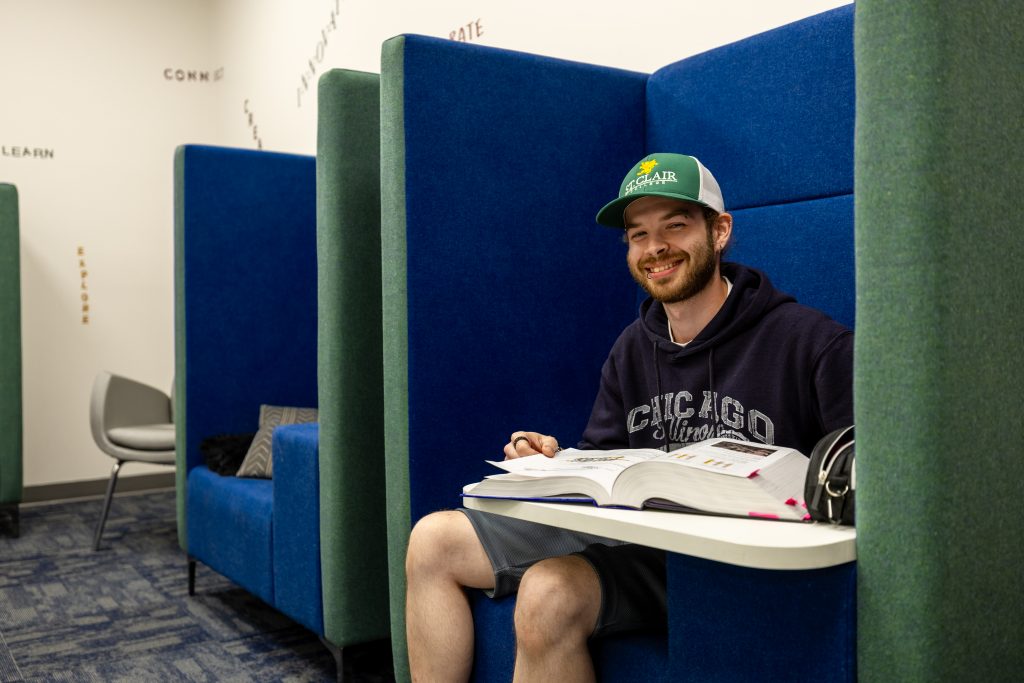
A youth completes homework in a Study Pod at the Windsor Essex Youth Wellness Hub.
As their relationship with CMHA-WECB evolved, the couple decided to give back and became involved in fundraising for the Youth Wellness Hub. The Jackson Oglan Charity Golf Tournament has been a striking success. A five-year project that ended this year, that has raised well over $275,000.
The Oglan’s experience exemplifies how the services of the CMHA can support families through difficult periods while also creating opportunities for community members to help others.
According to Ron, making mental-health resources accessible and encouraging open conversations are essential. “The fact that they can go to the hub and sit with counsellors and talk about the issues that they might have, it really is allowing us to take the stigma away from mental health,” says Oglan. “And so the more we communicate, the more we have these fundraisers, the more we talk about it, the less stigma will be out there.”
Healthcare without barriers
Providing healthcare to Windsor’s shelters can be incredibly challenging. However, a partnership between CMHA-WECB, Windsor Shelter Health Associates (WSHA), Windsor Regional Hospital, and the City of Windsor is bringing primary care and mental health services to people who are experiencing homelessness and home insecurity.
Dr. Jennifer Bondy, the medical director of WSHA, describes their relationship with CMHA-WECB as a close and collaborative one. CMHA-WECB provides much of the administrative and clinical support required to operate the clinics, including scheduling, hiring, staff training, and continuing education. The partners communicate regularly to ensure services run smoothly and patients receive appropriate care.
“Mental health diagnoses know no bounds,” says Bondy. “They can affect anyone, regardless of their socioeconomic background or circumstances. There are a tremendous number of resources available through CMHA-WECB, including individual counselling, group programs, and access to primary health care.”
There are a wide variety of needs that the WSHA may attend to, as some patients are living with psychiatric conditions, substance-use disorders, or other complex needs. Bringing medical, nursing, and social-work expertise into the shelters, the team can provide care and help people connect with further support.
“A lot of that involves an understanding of the context of the individual patient and what mental health challenges they may have encountered in the past and recognizing that, acknowledging it, validating it, and then working towards solutions with the patients,” explains Bondy.
Bondy also adds that talking openly about mental health helps people understand their experiences, and to also recognize that they are not alone and that there are resources that can help. She credits CMHA-WECB’s leadership and staff with playing an important role in developing the partnership, and proof of the importance of organizations working together to meet community needs.

Staff at the Windsor-Essex Youth Wellness Hub
When collaboration changes care
Dr. Corina Velehorschi, the chief of the Department of Psychiatry at Windsor Regional Hospital, states that the relationship between the hospital and the CMHA has grown considerably under Sbrocca’s leadership.
“In a matter of weeks to a few months, we accomplished what had eluded us for over a decade,” states Velehorschi. “Whatever we’ve had and whatever they’ve had, we’re able to put together regardless of the boundaries of the organizations.”
Over the last two years, the two organizations have worked together to establish several outpatient services intended to address our community’s gaps in psychiatric care. Seeing the needs of the local community, WRH and CMHA-WECB collaborated to create clinics to help people with community treatment orders following discharge, another for psychiatric follow-up for patients with complex needs, and one for people living with borderline personality disorder in need of consistent community-based treatment. Velehorschi says these initiatives became possible by bringing together resources and expertise from both organizations.
“I can say with a lot of enthusiasm that when Nicole came on in her position, she hit the ground running and she hasn’t stopped,” praises Velehorschi. “Rather than being constrained by organizational boundaries, this is an organization that has recognized how important collaboration, aligning resources, building partnerships grounded in mutual respect and shared responsibility.”
For patients, these partnerships help establish connections to appropriate services after leaving the hospital, particularly when ongoing psychiatric care is needed. Velehorschi, who has worked in the community for more than two decades, says the progress demonstrates what can happen when organizations come together with a shared focus.

Building a healthier Windsor-Essex
CMHA-WECB continues to encourage conversations about health and well-being through community initiatives. Combating mental health stigma remains a key priority in their ongoing efforts. Their annual Push-Up Challenge, a national CMHA initiative, encourages participants to get active, raise funds, and spread the word about mental health. According to the organization, local participation has generated more than $40,000 annually in each of the last two years.
Walking Wednesdays, in partnership with the City of Windsor during Mental Health Month in May, offers another opportunity to bring people together through physical activity and conversation.
Another fascinating partnership CMHA-WECB is partaking in is with The Drive Magazine. The project, Faces of Windsor, is a photo-book project inspired by the well-received Humans of New York book series by author and photographer Brandon Stanton. Photographers have been capturing candid portraits of people throughout Windsor and Essex County, accompanied by responses to questions about their lives and experiences. The project aims to present people authentically and encourage readers to look beyond assumptions about others.
“Mental health doesn’t have a face,” says CMHA director of communications Kim Willis. “It’s all of us.”
The project took root from an idea by a frontline staff member who wanted to bring a similar concept to Windsor-Essex. The book is an effort to encourage understanding, challenge stereotypes, and remind people that everyone has a story worth hearing.
Community awareness is an important complement to providing services. The more people understand mental health and know where to find support, the easier it becomes to start conversations and seek assistance when needed.

Looking ahead
As Windsor-Essex continues to grow and evolve, CMHA-WECB prepares for the needs that lie ahead. Sbrocca points to the strength of the local healthcare network and the importance of providers working together as the region faces an aging population and increasing demand on services.
Prevention and early intervention remain key priorities for CMHA-WECB, with the goal of helping people access the right support before challenges become more difficult to manage. To meet these needs, the organization is focused on expanding its capacity to reach more people and respond to emerging community priorities. This will require not only continued investment in programs and services, but also fundraising to secure the physical space necessary to accommodate future demand. Community support and philanthropic partnerships will be essential to creating welcoming, accessible environments where CMHA-WECB can deliver vital mental health and wellness services to more people across Windsor-Essex.
However, their goals remain rooted in the organization’s relationship with the people it serves. CMHA-WECB’s work spans different ages, circumstances, and health needs, and remains committed to helping people find the support that is right for them.
“We are here to care for this community in all shapes and sizes,” states Sbrocca. “And there’s no wrong door when it comes to CMHA-WECB.”
With 55 years of impact behind it, CMHA Windsor-Essex is building momentum for the future—connecting people to the care they need, forging stronger partnerships, and championing a community where mental health is recognized as an essential part of overall health. Looking ahead, the vision is bigger than expanding services—it’s about transforming lives, breaking down barriers, and creating a future where no one must face a mental health challenge alone, and everyone has the opportunity to feel supported, find hope, and thrive.