
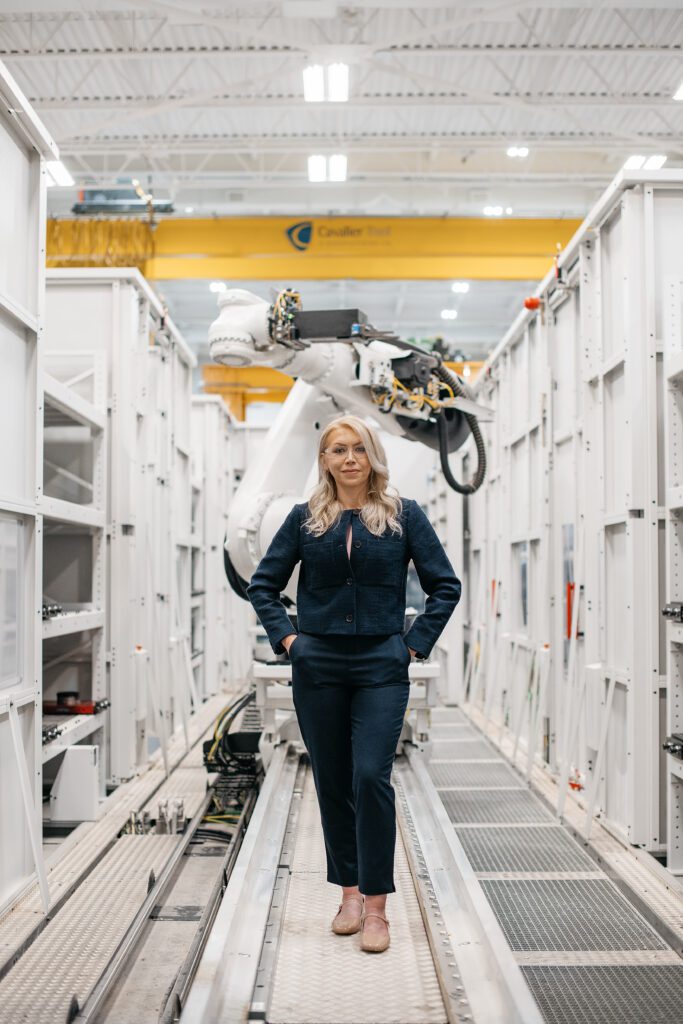
Led by one Windsor woman and a committed group of volunteer board members representing an industry, the Canadian Association of Moldmakers is the body behind the people who make things that make things. The Drive spoke with the Association’s executive director about the future of manufacturing, advocacy, and how her son’s passion for videogames may help create a stronger, more capable manufacturing workforce in Ontario.
Some site visits, if the workshop fans are angled just right, Nicole Vlanich’s work feels a lot like family.
“When I walk into one of our member shops,” relates Vlanich, whose father enjoyed a long career as a millwright in the tool and die industry, “certain smells remind of my childhood, of the way my dad smelled after coming home from work.”
Today, Vlanich is executive director of the Canadian Association of Moldmakers (CAMM), a not-for-profit alliance representing mould1 makers and associated suppliers to the global plastics industries. Vlanich, CAMM’s only full-time staffer, works closely with a board of directors comprising industry leaders in Windsor-Essex and beyond, to help guide the Association’s strategic priorities, advocacy efforts, and long-term vision for mould making. Together, staff and board leadership work to secure the future of a resilient sector that continues to provide meaningful, sustaining employment for thousands of Canadian families.
Mould makers are highly specialized skilled tradespeople who design, build, maintain, and fit precision production tools essential to advanced manufacturing – particularly plastics processing. While mould making, especially in Windsor-Essex, often supplies the automotive industry, it is also a critical supply chain component in sectors like medical equipment, packaging, and consumer goods.
Mould making aligns naturally with the tool and die trade, a similar vocation with which it shares overlapping core functions and equipment. Broadly: Mould making supplies forms for the plastic industry, while tool and die serves manufacturers working with metals and alloys.
According to Vlanich, hundreds of thousands of Ontario’s manufacturing jobs live downstream from mould making, meaning they indirectly rely on the skill and labour of CAMM’s members. “Mould making represents a small but highly leveraged segment within the broader manufacturing workforce,” says Vlanich. “Without sufficient skilled mould makers and related trades, production cannot scale, quality cannot be assured, and investment decisions are affected.”
The implications are colossally consequential for the province: While our economy is evolving, manufacturing still employs more than 800,000 Ontarians. Plastics and rubber product manufacturing, specifically, accounts for upwards of 40,000 of them across more than 800 companies. (Nationally, Canada boasts approximately 2,600 companies in that sector.)
Vlanich assumed her post in 2021, joining an Association still finding its feet in a manufacturing sector besieged and, it would turn out, permanently altered by COVID-19. “Everything was in turmoil,” she recalls. “I sat quietly at roundtables with members, and as a result, the CAMM we were before, we’re not that anymore. We’re now adding value to membership by listening to our members when they tell us what they need.”
Under Vlanich, CAMM offers its members a unified public- and government-facing voice on topics concerning mould making in Canada, lobbying multiple levels of government and communicating with the public to promote, preserve, and protect the industry’s interests. CAMM drives innovation and supports growth by hosting workshops, webinars, networking events, and peer support services; aggregating industry news, publishing toolkits, and maintaining an online “resource-centred innovation hub”; and making professional introductions that foster mutually beneficial industry relationships. That work is reinforced by CAMM’s board of directors, the members of which bring frontline manufacturing expertise to help ensure the Association’s priorities remain aligned with the needs of employers, workers, and the broader sector.
CEO and President of Maidstone’s LAVAL Tool & Mould, Jonathon Azzopardi is the interim director at large of CAMM’s nine-person board. According to him, CAMM is best understood as the voice and face of mould makers in the country. “Our Association plays a critical role in uniting mould makers across Canada,” Azzopardi shares. “Our industry requires an organization that can undertake initiatives individual owner-operators often cannot pursue independently; for example, government advocacy is a complex and often lengthy process, and international trade shows present logistical challenges and significant time commitments.”
Lately, CAMM’s major advocacy push focuses on getting mould making recognized by Red Seal, the highest interprovincial certification framework for tradespeople in Canada. The exam-based credential effectively functions as a skilled trades passport: Red Seal-recognized trades share common standards across provinces, so certified tradespeople enjoy increased mobility, and new cross-provincial supply chains become viable.
“Currently, if a mould maker in Quebec – the only other province that really has mould making – wants to move to Ontario, they can’t work,” Vlanich explains. “And vice versa. That impacts wages, certification, and the overall appeal to the trade.”
The Red Seal designation is also a broadly understood public-facing stamp of approval. Its current absence means career guidance lacks clarity and consistency, compromising recruitment; prospective trainees and their parents may not consider mould making as a legitimate career option.
Vlanich, a double University of Windsor Social Sciences graduate, is a mom of five. Last year, a conversation with one of her sons ventured into an exciting initiative Vlanich calls “the biggest thing CAMM’s ever done.”

TechBridge is a workforce development initiative aiming to bolster the manufacturing sector by engaging and training new mould makers in innovative ways. Launched in April 2025 with support from the Ontario Skills Development Fund and federal government grants, TechBridge combines self-directed e-learning modules with immersive virtual reality (VR) experiences to build expertise in areas like shop safety, measurement, computer-aided design (CAD), and computer numerical control (CNC) operations. The initiative also reflects a broader strategic priority of CAMM’s board: strengthening the future talent pipeline and modernizing how the industry attracts, trains, and retains workers.
“One of my sons is a videogame connoisseur,” says Vlanich. “We were discussing VR and augmented reality (AR) and how advanced it’s become, particularly in Japan and China. That’s where the idea of virtual training came from. I didn’t want to redo something that other organizations in the trades were already doing.”
Vlanich worked closely with Work Based Learning Consortium, a federally incorporated not-for-profit, to build TechBridge’s online training component. Virtualware, a multinational enterprise software company with a Hamilton office, delivered the initiative’s VR component.
TechBridge offers VR-based training courses in mould shop safety essentials, CNC mill training, and CNC lathe training. Candidates are invited to strap on VR headsets at a CAMM-sponsored installation within the Job Shoppe in Tecumseh.
“A Day in the Life of a Mold Maker” is an additional VR simulation geared toward youth and young adults that takes participants from lacing up a pair of work boots all the way to admiring a finished plastic product. Vlanich spent much of October (“Manufacturing Month”) teaming up with local manufacturers to tour schools with CAMM’s VR simulator. (CAMM already liaises with secondary and post-secondary education to help facilitate co-op placements, clarify career pathway information, and address myths and misconceptions about the industry.)
The TechBridge program also offers “wraparound supports” including wage subsidies for employers committed to training new hires and upskilling current employees; stipends to trainees who would otherwise go unpaid when training; and direct trainee benefits like childcare, transportation, relocation support, and tool and gear assistance.
According to Vlanich, TechBridge certificate-holders have sufficient entry level knowledge to walk right into the workforce or embark on a more structured and substantive post-secondary career path. “It’s really there for anybody,” she explains.
Early feedback from TechBridge’s first 200 trainees has been overwhelmingly positive: 92 percent rated the experience “very good” or “excellent,” and even more indicated they felt confident in the skills and knowledge they’d acquired.
Windsor’s Cavalier Tool & Manufacturing has been instrumental in the development and rollout of the program. “They’ve been huge supporters,” Vlanich stresses. “I wore them out in October with all the school visits.”
(Cavalier was also instrumental in this feature! The Drive thanks you for letting us photograph in your facility!)
According to President Brian Bendig, Cavalier boasts over 200 employees, over half of whom earn six-figure salaries. Despite the evident opportunity, how to best recruit young people into mould making remains unresolved. “Everyone knows what a dentist, police officer, or doctor is, because they can see it and understand it,” he explains. “In our trade, how do we get people to look at who we are, what we do, and why we do it? It’s very hard. TechBridge is a good way people can gain insight into what the trade’s all about. They get to access a little window into our work, poke around, and see what we do and how we do it. Hopefully it will generate interest to get them to move in our direction.”
Speaking to Bendig, you get the sense our means not just Cavalier, but the entire industry. “While competition exists, our members have very good relationships,” confirms Vlanich. “It’s an interesting dynamic. Windsor-Essex is smaller than people realize; if a company is going through something new to them, there’s a very good chance the guy down the street has already gone through it. Through our membership network, they build up that rapport and those relationships. It’s a very friendly, happy industry. Our members are resilient, and they enjoy what they do.”

Natalia Stephen, president of Mississauga’s Compound Metal Coatings Inc., currently chairs the CAMM board. Vlanich credits her for assuming the role last spring, as TechBridge was rolling out and CAMM was enduring a transitional period. “She’s been instrumental in allowing me to do my job well and lead the organization through this project and upwards,” says Vlanich.
As board chair, Stephen also fulfills a broader governance role: working with her fellow directors to support CAMM’s growth, strengthen its industry voice, and help steward the Association through a period of expansion and change.
Over time, Stephen aims to continue to expand CAMM beyond Windsor-Essex and broaden its membership. “I think the plastic tooling industry should have one voice,” she states. “Mould makers, moulders, and plastic engineers have the same goal: to make good parts. It makes sense for us to be together.”
“This vision reflects the board’s larger goal of building a stronger, more connected national network for the sector,” adds Vlanich.
For now, Natalia is proud of CAMM’s progress in grassroots training and outreach. “TechBridge was a lot of hard work, but Nicole did an amazing job with the program,” she enthuses. “CAMM’s main success this year is how many people we managed to train, and how many school kids we reached and convinced manufacturing is not a dirty word.”
That sort of recruitment, it turns out, is important. Like many skilled trades, mould making faces meaningful demographic pressures as its existing workers age out. “A significant majority of the workforce is over 50,” clarifies Vlanich. “Only approximately 12 percent of retirees are being replaced.”
As Vlanich explains, that trend can’t continue indefinitely; many mould making shops already struggle to fill their ranks when business is booming. While an unexpected flurry of suppressive economic and geopolitical factors has temporarily alleviated that concern, the problem remains. “Our industry locally is getting contracts and creating work, but our members don’t have the bodies,” says Vlanich. “Mould making is such a vital industry to Windsor-Essex, our province, and Canada as a whole. Without workers, we don’t have it.”
While many area residents are understandably apprehensive about the future of our manufacturing careers amidst, well, everything going on lately, both Vlanich and Bendig are optimistic.
Through partnerships with organizations like Build a Dream, CAMM has made meaningful inroads with girls and women—an important emerging demographic for mould making. “Many women love these careers and thrive in them,” stresses Vlanich. “They’re often surprised by how welcoming it is.”
Some trainees are also surprised by the degree of advanced technologies, including robotics and automation, now embedded in the industry. “Many people still misconceive these are backbreaking labour positions in dirty and dingy facilities,” she shares. Over time, Vlanich foresees mould making work becoming less physically taxing and more intellectually stimulating as mould makers increasingly spend their work hours overseeing and coordinating sophisticated robotics-integrated production environments.
“But we will always need people,” she insists. “These jobs will not be stolen by AI or robots.”
“Plastics is are never going away,” concurs Bendig, whose own employees enjoy well-lit, climate-controlled workplaces. “Mould making has legs, because everyone uses and loves plastics. We’re always getting new equipment, updating, and growing to work on new products.
“This is a real career here—opportunity worth considering,” Bendig concludes, cataloguing his company’s relationships with major multinational corporations. Ford and Chrysler, yes, but also Rolls Royce, Tesla, and SpaceX.
“Isn’t it crazy?” he asks aloud. “We’re at that level. We do all that stuff here.”
“With a committed board, strong member leadership, and a growing mandate that now spans advocacy, workforce development, and industry promotion,” concludes Vlanich, “CAMM is positioning mould making not as simply a legacy trade, but as an essential part of Canada’s advanced manufacturing future.”
Peter Dobrich, managing partner of proud CAMM sponsor Private Financial Group (PFG), congratulates Nicole Vlanich and the board of directors on another successful year:
PFG considers CAMM a valued partner. My hardworking team and I appreciate that our mutually beneficial relationship is about much more than branding: Our businesses are rooted in a shared reality. CAMM’s network represents an industry that helps keep Canadian manufacturing competitive, and many of its founders are nearing the age of retirement. We believe manufacturers are some of the most disciplined people you’ll ever meet. We make sure that same discipline shows up in their personal planning, because you shouldn’t be gambling with what you’ve already worked so diligently to build.


